When a Restaurant Closes, the Slab Stays
Eastridge Family Restaurant on East Ridge Road is winding down after 46 years, with the owner preparing to retire from the business her parents started in 1980, as reported by RochesterFirst.
Whoever takes that space next inherits equipment, a hood, a grease trap, and a concrete slab that has absorbed four decades of hot water, fryer oil, dish soap, and dropped sheet pans.
The floor is almost never in the walkthrough conversation. It is usually the line item that blows up the buildout budget three weeks later.
What Forty Years of Service Actually Does to Concrete
Commercial kitchen floors do not fail all at once. They fail in a predictable order, and you can read that order during a site visit if you know where to look.
Grout lines go first. Quarry tile can look sound while the grout between it has eroded into a channel that wicks water straight down to the slab.
Once moisture and grease get under the tile, the bond lets go. You find it by tapping. A hollow ring means the tile is floating on nothing.
Below that, the concrete itself takes the damage. Years of acidic food waste and aggressive degreasers eat the cement paste and leave a soft, dusty, porous surface that will not hold a new coating until it is opened up and repaired.
The Zones That Fail First
If you are touring an older Rochester restaurant space, check these five areas before anything else. They tell you most of what you need to know.
| Zone | What to look for | What it usually means |
|---|---|---|
| Dish pit | Standing water, soft grout, stained slab | Constant saturation. Expect substrate repair. |
| Fry and grill line | Dark, slick, discolored surface | Grease has penetrated. Needs deep degreasing before prep. |
| Walk in threshold | Cracking and edge chipping | Thermal movement plus cart traffic. Needs a detailed transition. |
| Floor drains | Ponding water away from the drain | Bad slope. Fixing it is a slab job, not a coating job. |
| Wall base | Gaps at the cove, loose tile | Water is getting behind the wall. Health inspector territory. |
None of these are deal breakers on their own. All of them cost real money if you find them after you have signed and scheduled an opening date.
Why Coatings Have Replaced Tile in Turnover Work
Quarry tile was the default for the generation of Rochester restaurants that opened alongside Eastridge. It works, but every grout joint is a seam, and every seam is a place for water and bacteria to live.
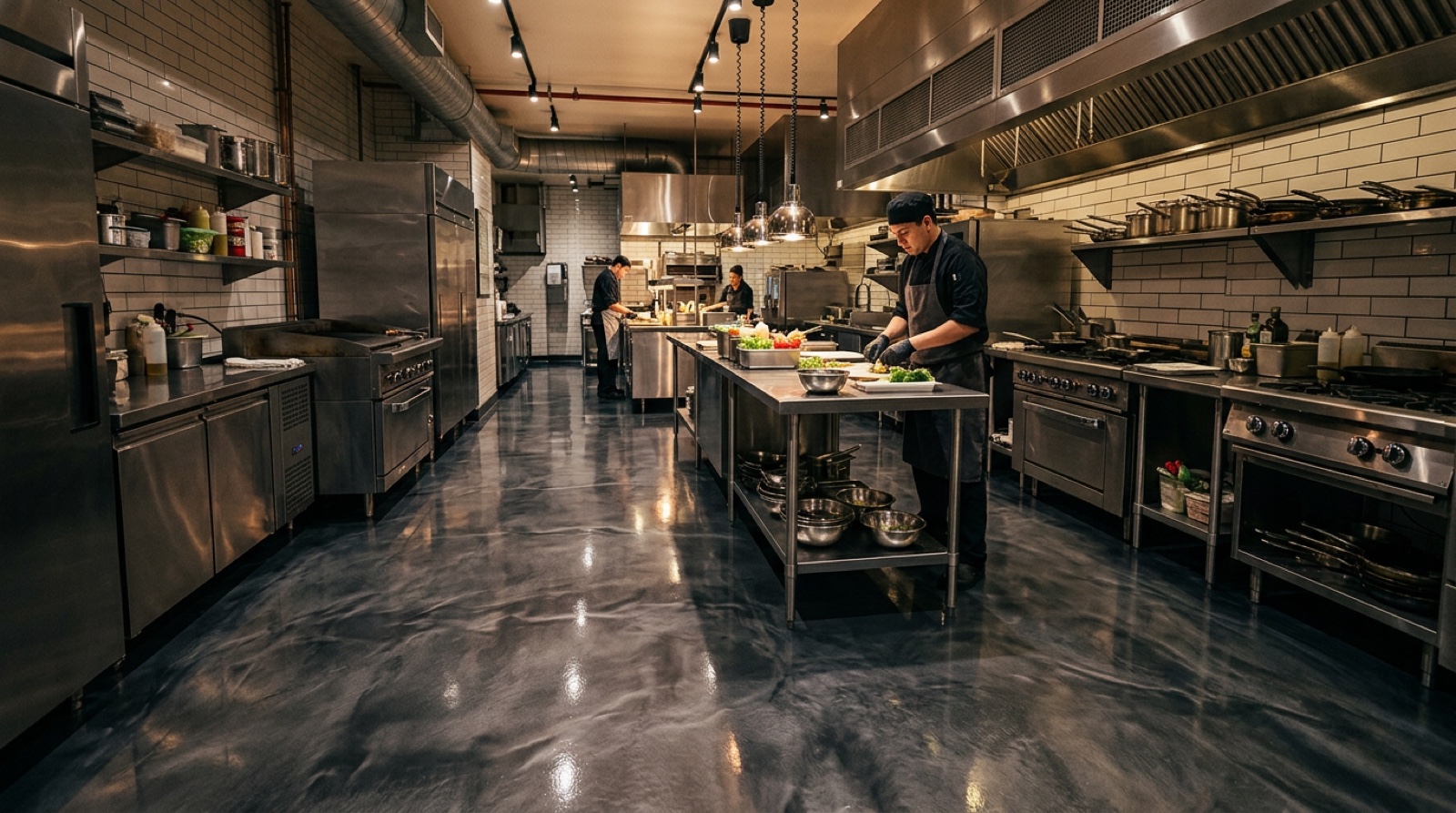
A resinous system removes the seams. A properly installed kitchen and food service floor is one continuous surface that runs up the wall as an integral cove, so there is no joint at the base for a mop to miss.
That matters for cleaning, and it matters for inspections. A monolithic surface with a coved base is far easier to keep in the condition an inspector wants to see.
It also matters for slip resistance. Broadcast aggregate can be dialed to the zone, heavier at the fry line and dish pit, lighter in the prep and service areas where carts move.
Front of house is a different problem
Dining rooms do not need chemical resistance. They need something that looks intentional and survives chair legs and winter salt tracked in from a Henrietta or Greece parking lot.
That is where polished concrete or a decorative system tends to win on cost per year. You are not paying for a kitchen grade buildup in a room that only sees foot traffic.
Rochester Timing Is the Constraint Nobody Plans For
Most restaurant turnovers here happen in a narrow window, and floor work sits on the critical path because nothing else can happen while it cures.
Standard epoxy generally wants several days between coats and before full service, and it gets slower as ambient temperatures drop. In an unheated or partially heated Monroe County building in November, that timeline stretches.
This is the practical argument for a polyaspartic topcoat. It cures fast and tolerates lower temperatures, which often means a floor installed over a weekend shutdown instead of a full week of lost revenue.
The tradeoff is working time. Polyaspartic sets quickly, so it is unforgiving of a crew that is guessing.
Prep Decides Everything
Every failed kitchen floor we get called to inspect failed for the same reason. Someone coated over a contaminated or unsound slab.
On a space like a decades-old diner, the sequence is not optional:
- Full tile and thinset removal down to bare concrete
- Aggressive degreasing, because grease that stays in the slab will push the new coating off
- Diamond grinding or shot blasting to an open, mechanically sound profile
- Repair of cracks, spalls, and soft areas before any resin goes down
- A moisture test, since old slabs in this region frequently sit on no vapor barrier at all
Skip any of those and you are buying the floor twice.
If You Are Looking at a Space Right Now
Get the floor evaluated before the lease is signed, not after. A one hour assessment tells you whether you are looking at a coating job or a demolition and slab repair job, and those are very different numbers.
We handle kitchens, dining rooms, breweries, and general commercial spaces across Rochester, Irondequoit, Brighton, Pittsford, and Webster.
If you are taking over an older building and want to know what is under the tile before you commit, reach out for a walkthrough and a quote.